New York Traffic Violations: When You Should Contact a Traffic Law Attorney
Getting pulled over in New York can lead to more than an inconvenient ticket. Depending on the alleged violation, your driving history, and the circumstances of the stop, a traffic matter may result in DMV points, fines and surcharges, increased insurance costs, license suspension, or even criminal charges.
For drivers in Poughkeepsie, Dutchess County, and throughout the Hudson Valley, understanding what you are facing—and what you do next—can make a significant difference.
Not every traffic ticket requires the same approach. Before simply pleading guilty and paying a fine, it is important to understand the potential consequences and whether an experienced New York traffic law attorney may be able to help protect your license and driving record.
Common Vehicle and Traffic Offenses in New York
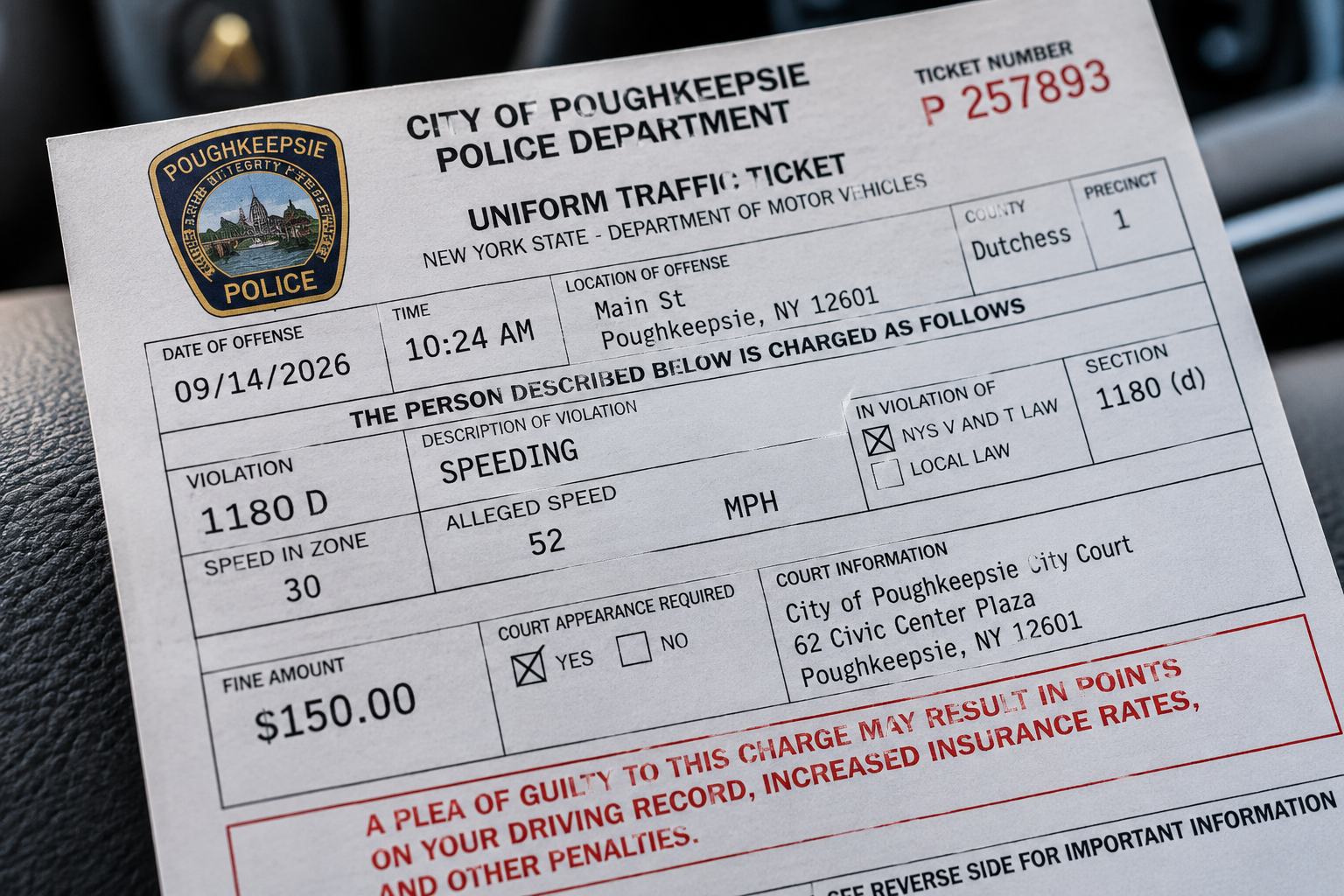
New York's Vehicle and Traffic Law covers a wide range of violations, from relatively common moving violations to offenses that can result in criminal charges.
Some of the traffic matters drivers may face include:
- Speeding tickets
- Reckless driving
- Failure to obey a traffic signal or stop sign
- Unsafe lane changes
- Following too closely
- Improper passing
- Cell phone and electronic device violations
- Driving with a suspended or revoked license
- Unlicensed operation
- CDL and commercial driver violations
- Leaving the scene of certain incidents
- Driving while ability impaired or intoxicated
- Other vehicle and traffic violations
The consequences vary significantly depending on the specific charge and the driver's history.
How Many Points Can a Traffic Ticket Add to Your New York License?
One of the most important considerations after receiving a traffic ticket is the number of points that may be added to your New York driving record following a conviction.
For example, New York DMV currently assigns speeding points based on how far above the posted speed limit a motorist is convicted of driving:
- 1–10 MPH over the limit: 3 points
- 11–20 MPH over: 4 points
- 21–30 MPH over: 6 points
- 31–40 MPH over: 8 points
- More than 40 MPH over: 11 points
Other violations can also carry substantial points. Reckless driving is currently assessed 5 points, following too closely is 4 points, and improper passing or an unsafe lane change is generally 3 points. New York DMV also assigns 5 points for certain cell phone and portable electronic device violations.
Points are only part of the potential financial impact of a conviction. Insurance companies use their own systems when evaluating risk and premiums, which are separate from the DMV point system.
Six or More Points Can Become Even More Expensive
Drivers should also be aware of New York's Driver Responsibility Assessment (DRA).
If you accumulate 6 or more points on your New York driving record within an 18-month period, DMV may require an additional assessment on top of the fines, penalties, and surcharges associated with the underlying convictions.
For 6 points, the current assessment is $100 per year for three years. Each additional point increases the annual assessment by $25. Certain alcohol- or drug-related driving convictions and chemical-test refusals carry a separate $250 annual assessment for three years.
This is one reason a ticket that initially appears manageable can have consequences extending well beyond the amount printed on a court notice.
When Does a New York Traffic Matter Become Criminal?
Not every traffic offense is simply a violation.
Reckless driving is one important example. Under New York Vehicle and Traffic Law § 1212, reckless driving involves operating a vehicle in a manner that unreasonably interferes with the free and proper use of a public highway or certain parking lots, or that unreasonably endangers others using them. Unlike an ordinary traffic infraction, reckless driving is a misdemeanor under New York law.
Other situations involving allegations such as impaired driving, aggravated unlicensed operation, leaving the scene of certain incidents, or conduct associated with an accident may also expose a driver to consequences beyond those of an ordinary traffic ticket.
When a traffic stop results in an arrest, criminal accusation, or the possibility of losing your driving privileges, contacting an attorney promptly becomes especially important.
What Should You Do After Receiving a Traffic Ticket in New York?
First, do not ignore the ticket or its deadlines. Failing to respond appropriately can create additional problems.
You should also avoid assuming that paying a ticket is always the easiest or least expensive solution. A guilty plea may resolve the immediate ticket, but the resulting conviction can affect your driving record and potentially create additional DMV or insurance consequences.
After receiving a ticket:
- Read the entire ticket carefully. Identify the exact violation, court, response instructions, and deadlines.
- Keep everything related to the stop. Save the ticket and any paperwork you received.
- Write down what happened. While the incident is fresh in your memory, record relevant details about the location, traffic, weather, signage, conversation with the officer, and circumstances surrounding the stop.
- Check your driving history. Previous convictions and points can significantly affect how a new traffic charge impacts you.
- Consider speaking with a traffic law attorney before entering a plea. An attorney can evaluate the specific allegations and potential consequences before you decide how to proceed.
Can a Traffic Law Attorney Get a Ticket Reduced?
There is no guaranteed outcome in a traffic case, and an attorney should not promise that a particular ticket will automatically be dismissed or reduced.
However, depending on the facts, court, prosecutor, driver's record, and charges involved, an attorney may be able to pursue options that reduce the consequences of the original charge.
A traffic attorney may review issues involving the traffic stop, evidence, charging documents, driver's history, and other circumstances to determine the appropriate strategy. Depending on the case, that could include challenging the allegations, seeking a reduction to a lesser offense, negotiating an available resolution, or preparing the matter for a hearing or trial.
The goal is not simply to make a ticket disappear. It is to pursue the most favorable realistic outcome while considering the potential effect on your license, points, finances, and future driving privileges.
Traffic Tickets Can Have Greater Consequences for CDL Drivers
For commercial drivers, protecting a driver's license can also mean protecting a career.
A traffic conviction that may seem manageable to a non-commercial driver can have additional professional consequences for someone who holds a Commercial Driver License (CDL). Employers, federal regulations, licensing requirements, and the nature of the particular violation can all affect the potential impact.
If your ability to earn a living depends on maintaining your driving privileges, it is particularly important to understand the consequences of a traffic charge before resolving it.
Traffic Violations in Poughkeepsie and the Hudson Valley
Drivers throughout the Hudson Valley regularly travel heavily trafficked state and local roads, including Route 9, Route 44/55, Route 52, the Taconic State Parkway, I-84, and other roadways throughout Dutchess County and the surrounding region.
Whether you are a local resident, commuter, commercial driver, college student, or visitor who received a ticket while traveling through the area, a New York traffic violation should not automatically be treated as "just a ticket."
The potential consequences depend on the actual charge and your individual circumstances.
How LeGrady Law Can Help With New York Traffic Violations
At LeGrady Law, Attorney Ryan LeGrady represents clients facing vehicle offenses and traffic violations in Poughkeepsie, Dutchess County, and throughout the Hudson Valley.
As a former New York prosecutor and former Assistant Attorney General, Attorney LeGrady brings valuable insight into how cases are evaluated and prosecuted. He carefully reviews the circumstances surrounding each traffic matter and develops a strategy based on the client's specific situation.
Depending on the case, representation may involve:
- Reviewing the traffic stop and allegations
- Evaluating the evidence against you
- Identifying possible defenses
- Seeking reductions when appropriate
- Challenging charges when warranted
- Helping minimize points and other consequences where possible
- Addressing license suspension and driving privilege concerns
- Representing drivers facing more serious vehicle-related allegations
- Helping CDL holders understand the potential impact on their livelihood
Every case is different, and past results cannot guarantee a particular outcome. The first step is understanding exactly what you are facing.
Received a Traffic Ticket or Facing a Vehicle Offense in New York?
The decision you make after receiving a traffic ticket can affect more than the fine itself.
If you received a speeding ticket, are facing a license suspension, have been accused of reckless driving, are dealing with a CDL violation, or have been charged with another vehicle or traffic offense, speak with an attorney before making decisions that could affect your driving record.
Contact LeGrady Law to discuss your traffic matter and learn about your legal options.
Serving clients in Poughkeepsie, Dutchess County, and throughout the Hudson Valley.
Call (845) 216-0917 to contact LeGrady Law.